

What do you do when you can’t find what you want through the regular distribution channels? You have to contact somebody to make it per your requirements or you make it yourself. I decided to take the latter option 🙂
This is a project I made some years ago. At that time I didn’t really consider writing a blog about it so I don’t have detailed pictures of all the production steps.
Concept & design
When starting to design something it is always best to first list your requirements and expectations. During the design process it is easy to get carried away. Having those initial requirements makes it easier to check if your solution really covers your needs and get back with your feet on the ground.
What did we want for our dining table? It was going to be the focal point of our daily family life so it had to offer a lot of space and comfort. So, first of all I wanted it to be solid and I mean, really SOLID. Secondly it had to be easy in daily use and cleaning. A plain table top, no special edges, no protruding legs, no crevices. Thirdly it needed to look straightforward, I wanted it to shine by its simplicity. Fourthly it was going to be a table for now to eternity so I preferred massive wood so it could be resanded when needed and treated again. Lastly, we wanted it to sit up to 10 persons in its ‘daily’ mode and 14 persons when extended.
Now that we know the requirements, the design process can start. I will save you all the different iterations this table went through and present you the outcome. After some real life testing we decided that we wanted 60cm seating space per person. If we made the table 100cm wide, it would allow for a person to also comfortably sit at the head of the table. So in order to sit 10 people comfortably, the table needed to be 240cm long and 100cm wide. In it’s extended mode 2 extensions of 60cm would need to be added. For the height we checked with existing tables that 78cm was good.
As we wanted a flat table top without crevices any extensions would need to be added on the extremities when required an not in the middle of an opening table top.
I had come up with a design where the table extensions would be hidden in drawers at each head of the table. These same drawers would then serve as supports for these extensions once installed. The system looked really handy and allowed for the complete table to be in ‘one’ place. Extending it was going to be a piece of cake. This table would need some aprons and skirts at the sides in order to hide the drawers for the extensions.
Although it looked like a very nice table, I wasn’t happy with it. It took some time to discover why I wasn’t satisfied with this design but finally I realized that it wasn’t simple enough.
KISS !! A top and 4 legs! More isn’t needed to make a table. Here I was adding extensions, drawers and skirts because a few times a year we wanted to sit more people. I was penalizing day to day usage in order to facilitate the occasional extension.
Back to basics: Only A top and 4 legs. The two extensions would be stored in a storage space under the stairs.
I really liked the following concept: https://woodweb.com/cgi-bin/forums/furniture.pl?read=752449
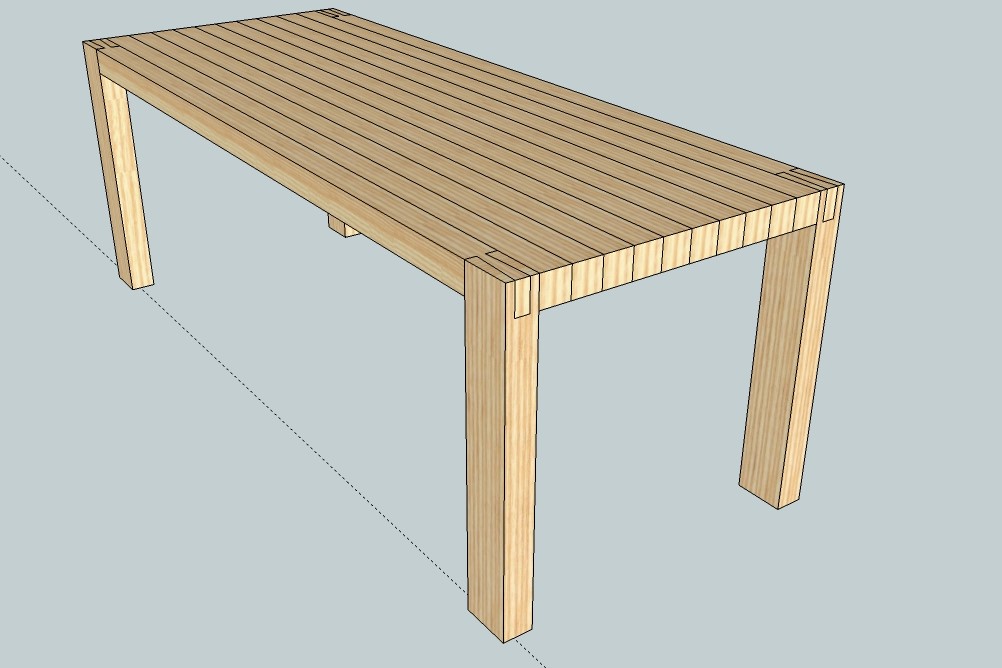
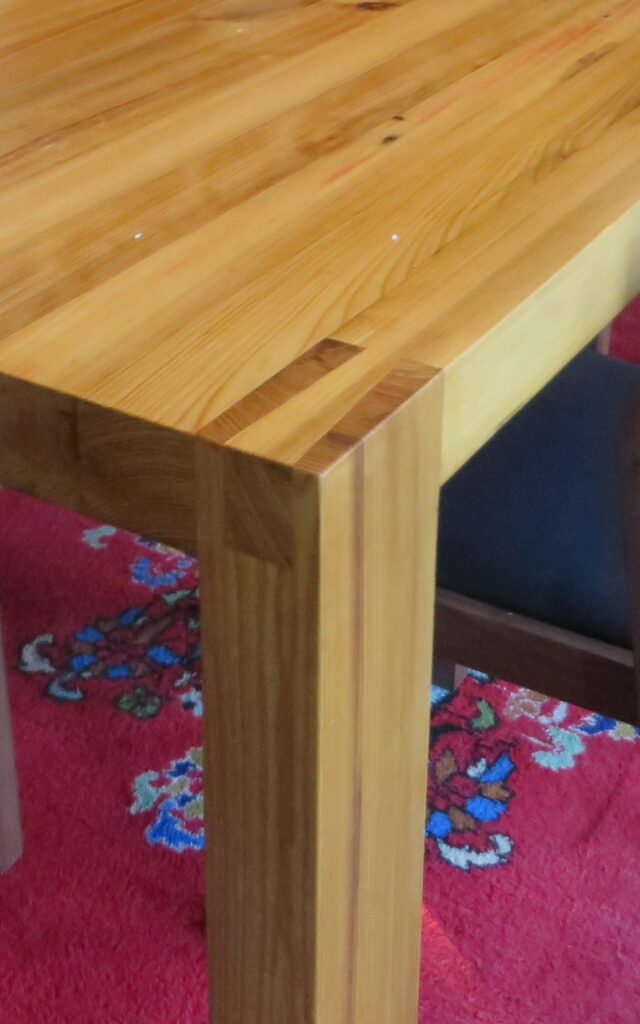
The table top in this design is 70mm thick. I wanted something sleeker looking and decided that a 40mm top would still be sufficiently strong without needing a table frame below it in support. But with a 40mm thick top the above idea for fixing the legs would lose much of its strength… And how was I going to mount the extensions to this table? I estimated the weight of the table with a 40mm table top somewhere around 110kg. I considered this to be too heavy to handle comfortably when making it. Moving it around finished, considering dimensions and weight, would be hell. The top alone would weigh around 70kg but would be a simple board so quite a lot easier to handle.
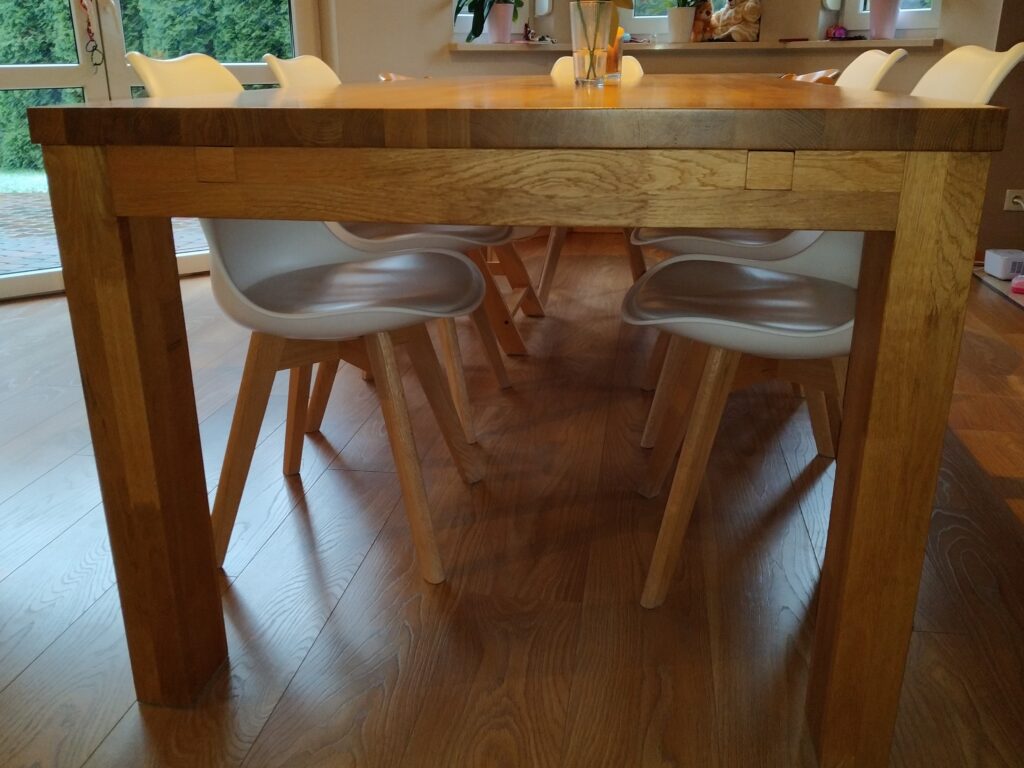
Putting two and two together I decided to make the legs detachable and mount them as an inverse U under the table ends. I could take a horizontal beam sufficiently thick to assure a solid connection of the legs to it. The beam would also be able to support arms for the table extensions.
For the material I had already kind of decided that I liked the look of oak panels made out of glued staves. I think they look more modern then panels glued up of full boards and they should be more stable in the long run.
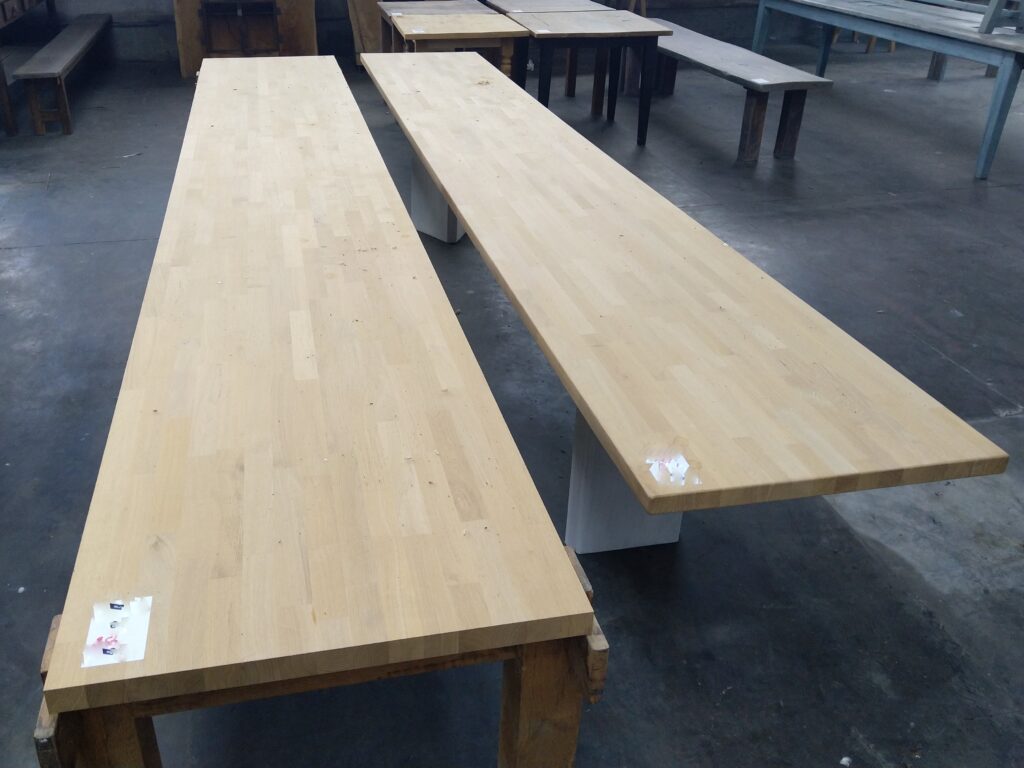
I didn’t really want to glue up the top myself. It seemed like lot of repetitive work…. But I couldn’t find a glued top of that dimensions until I accidentally came across 2 very well priced kitchen tops (400x65x4cm) at a sell-off auction. I didn’t hesitate.
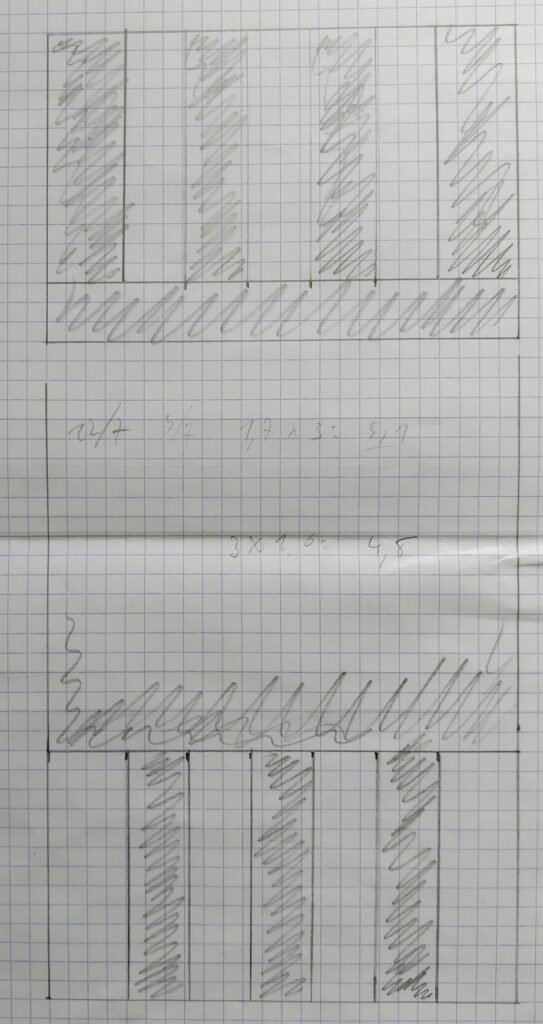
So now I had 2 tops 400x65x4cm as raw material for my table. Legs with a dimension of 12×8 cm would look nice proportionally to the rest of the table and it would be quite easy to make them when gluing the 4cm boards together. For the horizontal part of the upside down U I also considered the same 12x8cm beam.
A sketch showed that the two tops I purchased would provide just enough material for the table top, the extensions, the legs and still allow for some sawing losses. The pieces of the puzzle seemed to fit nicely together. To support the extensions I would be able to make some beams out of an old table frame which was sold together with the tops.
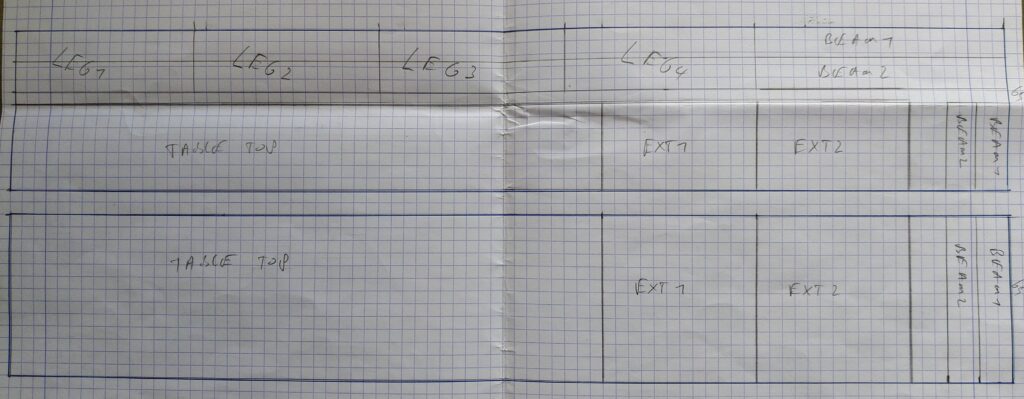
I cut all the main pieces roughly to size with a circular saw and a straight edge, planning on straitening them up later on. (I didn’t have a track saw.)
Table top
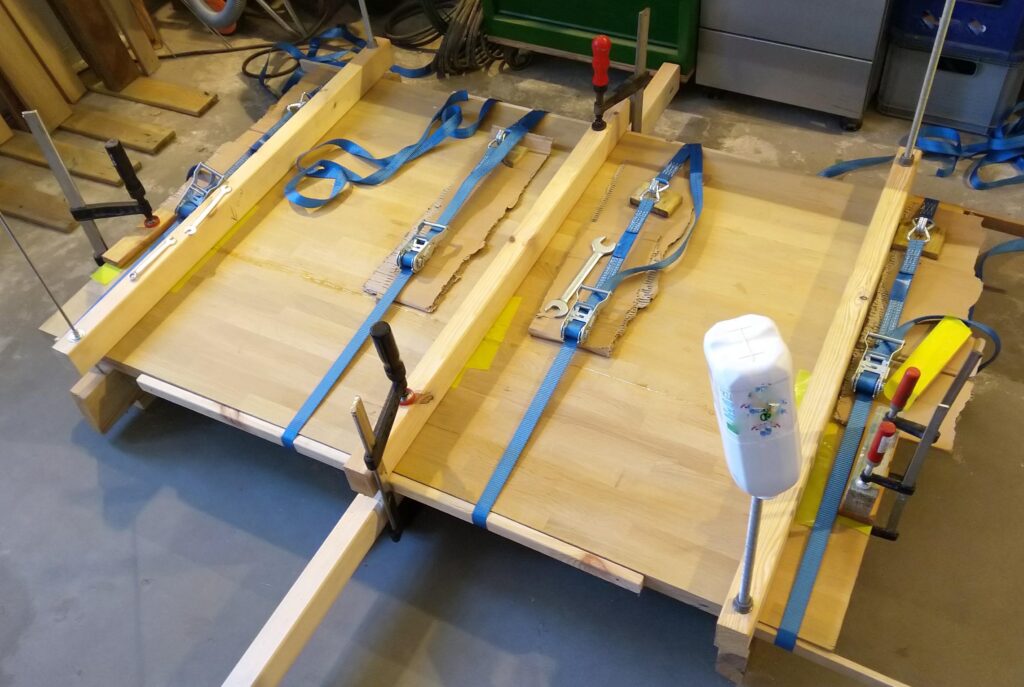
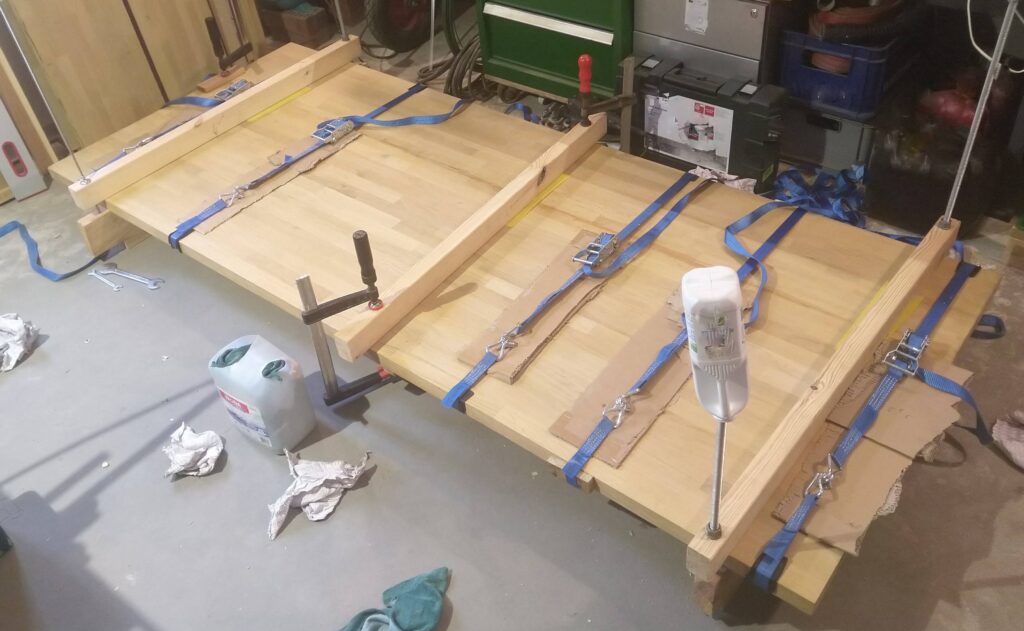
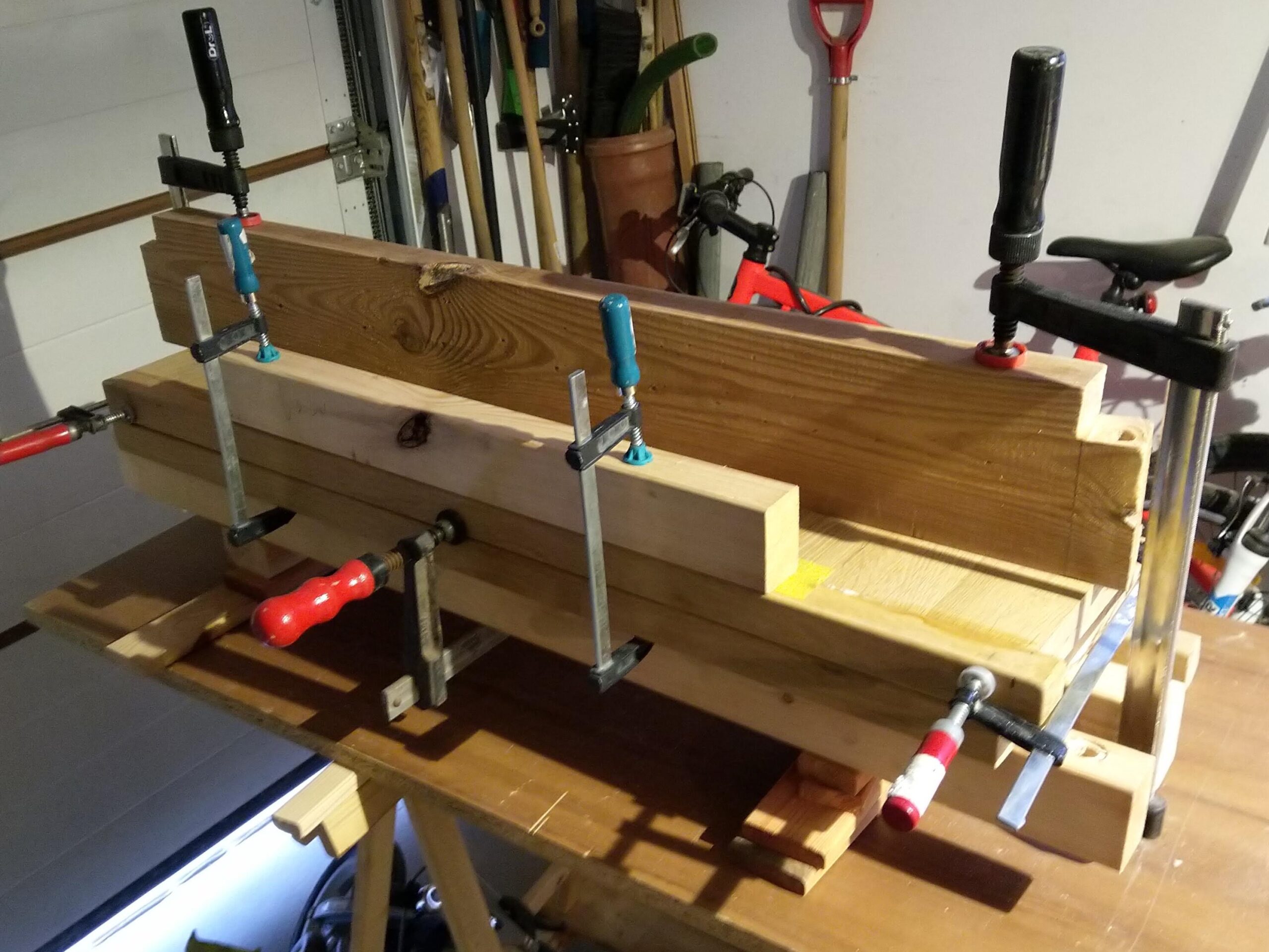
First I glued the parts for the table top and extensions together. Before gluing, I straightened out the two joining edges with a plane. Lacking long pipe clamps I used ratchet straps to squeeze the boards together. The extensions I glued together as one big board, planning on cutting it in two afterwards.
Legs
While those were drying, I was considering how I could assemble the ‘U’s for the table legs. I didn’t want any screws or joints to be visible and I wanted them to be really solid. I decided that my best option would be a lapped tooth and groove connection. I made various sketches to get a better feel and to decide how I would execute the joint.
Was I going to connect them with a bridle or a dovetail joint? The latter definitely being stronger but never having done a lapped tooth and groove connection I opted for the bridle joint.
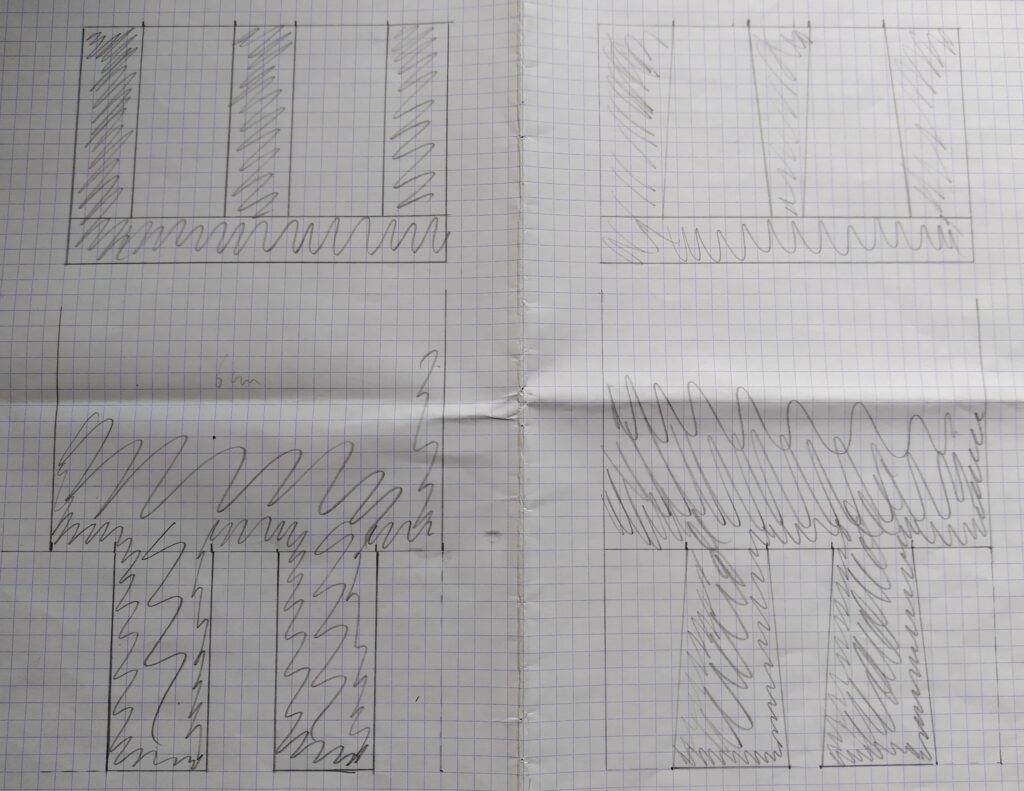
A 2 cm or 1.5 cm lap for the joint? On the paper drawing the 1.5 cm lap seemed to be more than sufficient.
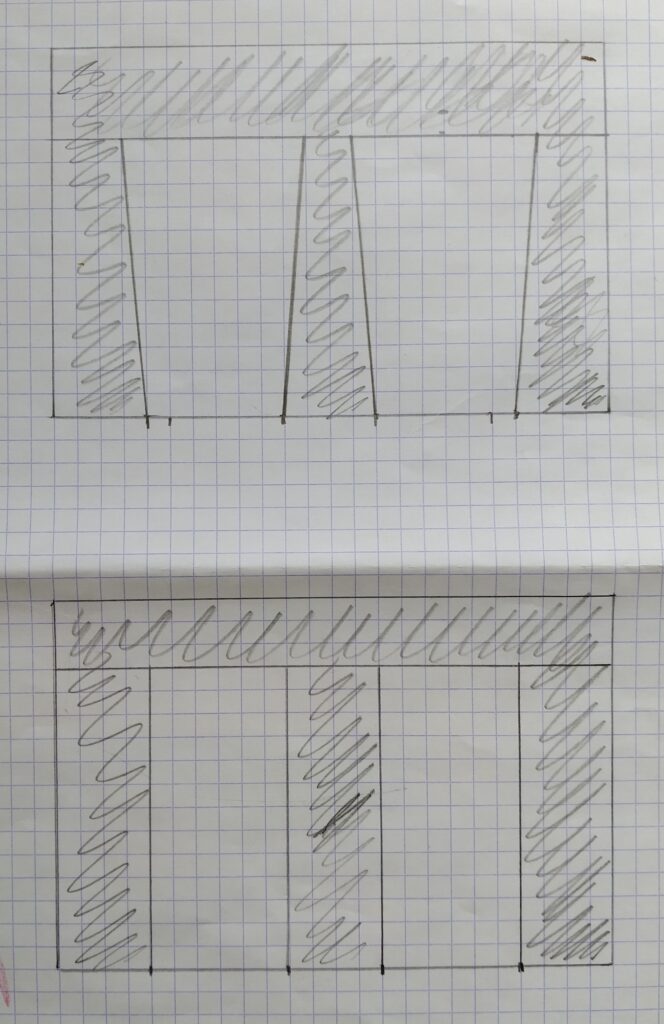
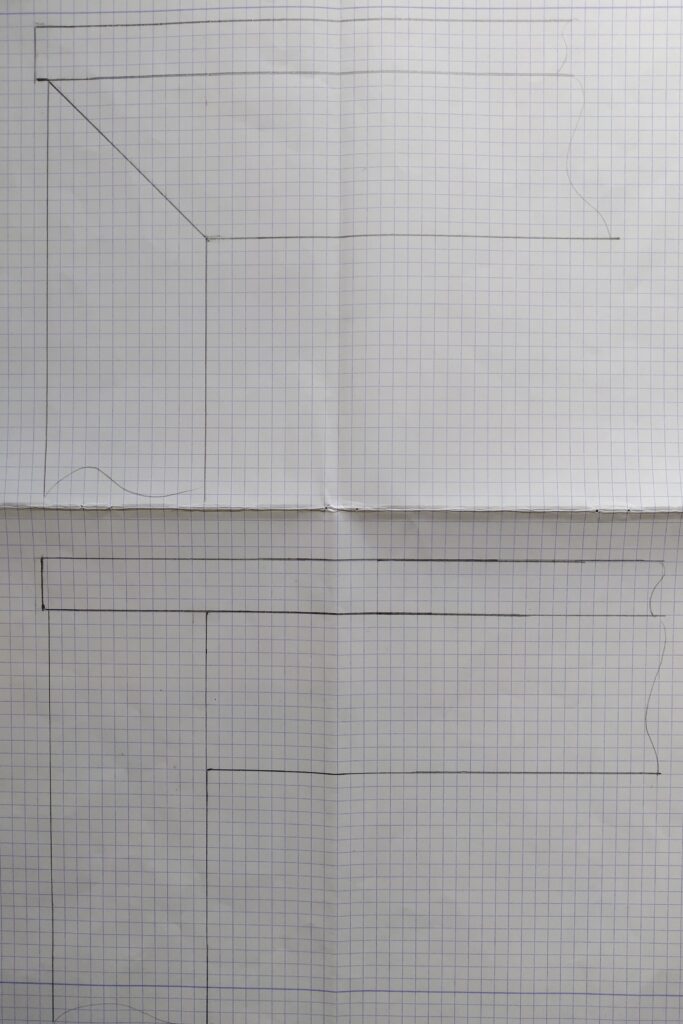
Should I make the connection between the beam and the legs with a straight or a mitred bridle? I liked the looks of the straight one better in the overall concept of the table and it would be easier to make.
After lengthy research and considerations I decided to go for a straight lapped triple tooth bridle joint. The bridle joint is easier to make than a dovetail joint. I decided to have three teeth as I felt that it would be the most optimal trade off between tooth strength and glueing surface.
I had never made a tooth and groove connection before so I decided to give it a try first and I made a pine square with one joint being a tooth and groove.
Once I was decided upon the assembly method for the legs I glued the various leg boards together to get 8 cm thick pieces. Once dry, I ripped them in half and ripped them to size so I came to have 6 pieces of equal width (12cm). 4 of them a little longer than 75 cm for the legs and two a little over 100cm for the beams. I squared one end of the legs, here I would make the teeth.
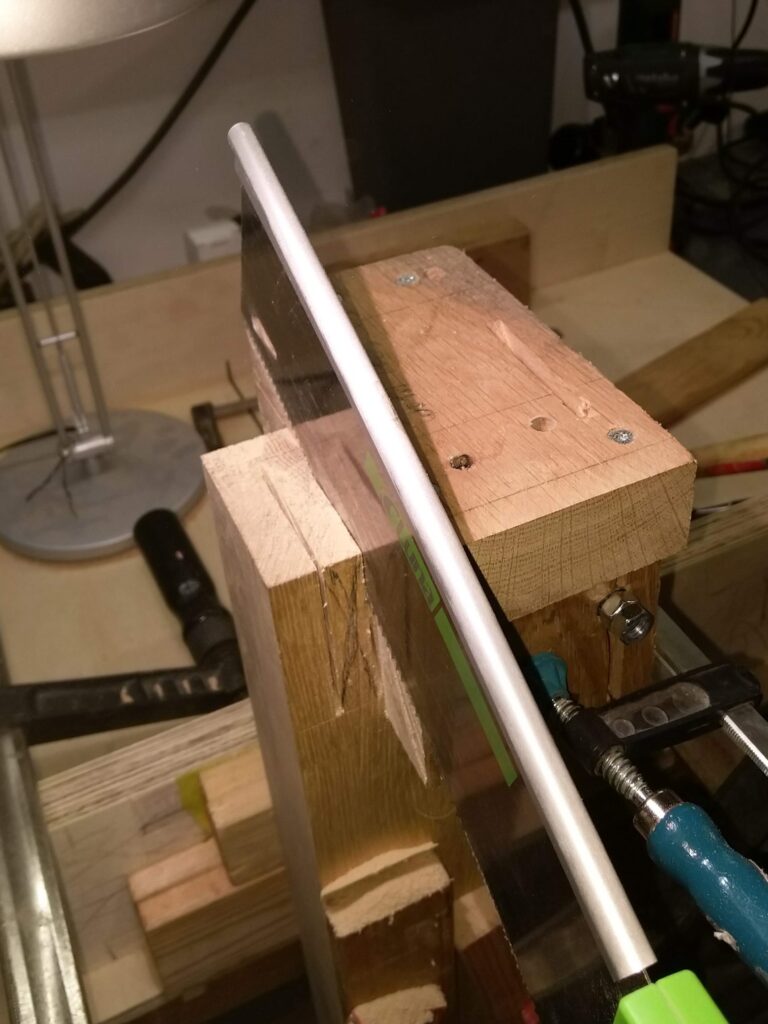
Now I started with making the grooves in a leg. I made a special wooden clamp which would exactly grip around the 8cm legs and would be able to guide my saw when sawing. I carefully marked out the teeth and sawed them as far as I could.
Next I put the clamp on the lower part, to protect the leg while chiselling and I started to hammer away. Keeping everything square is key here. For the sides I could reference the chisel off the parts which I cut with the saw. For the bottom of the groove I referenced my chisel of a board which I had clamped against the leg. This really was a very time consuming step. Making the grooves to thin would not allow the teeth in, making them to wide and the teeth would not fit snugly. I decided to rather have them a little to thin and adjust once the teeth would be ready and I would try to fit them.
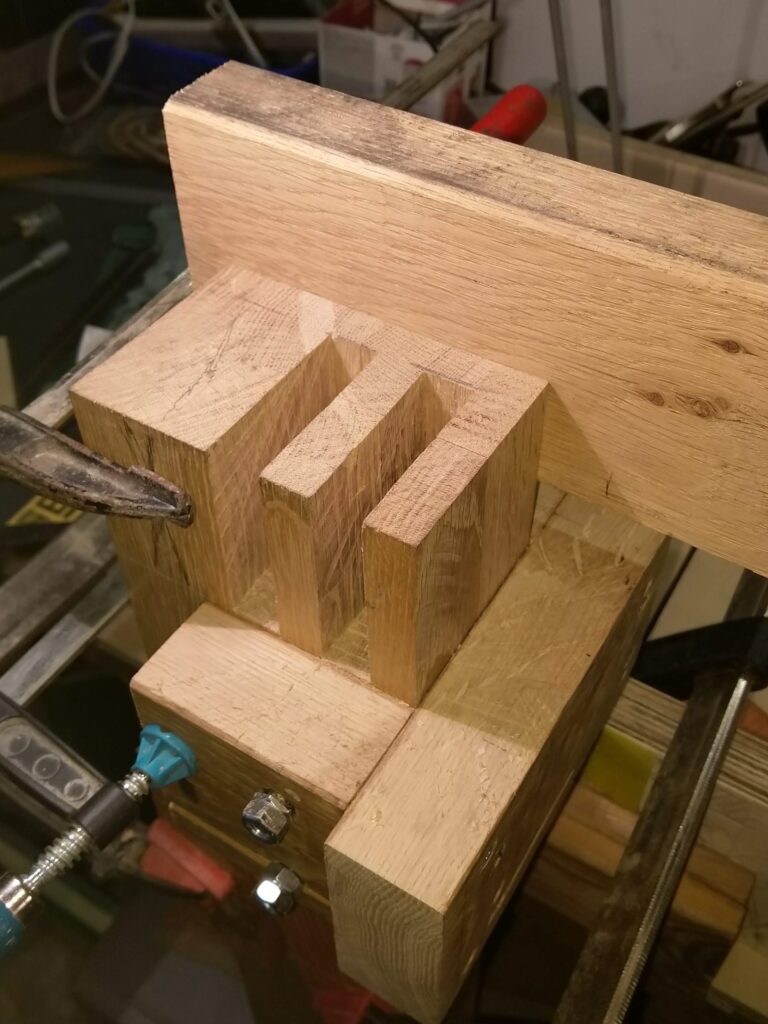
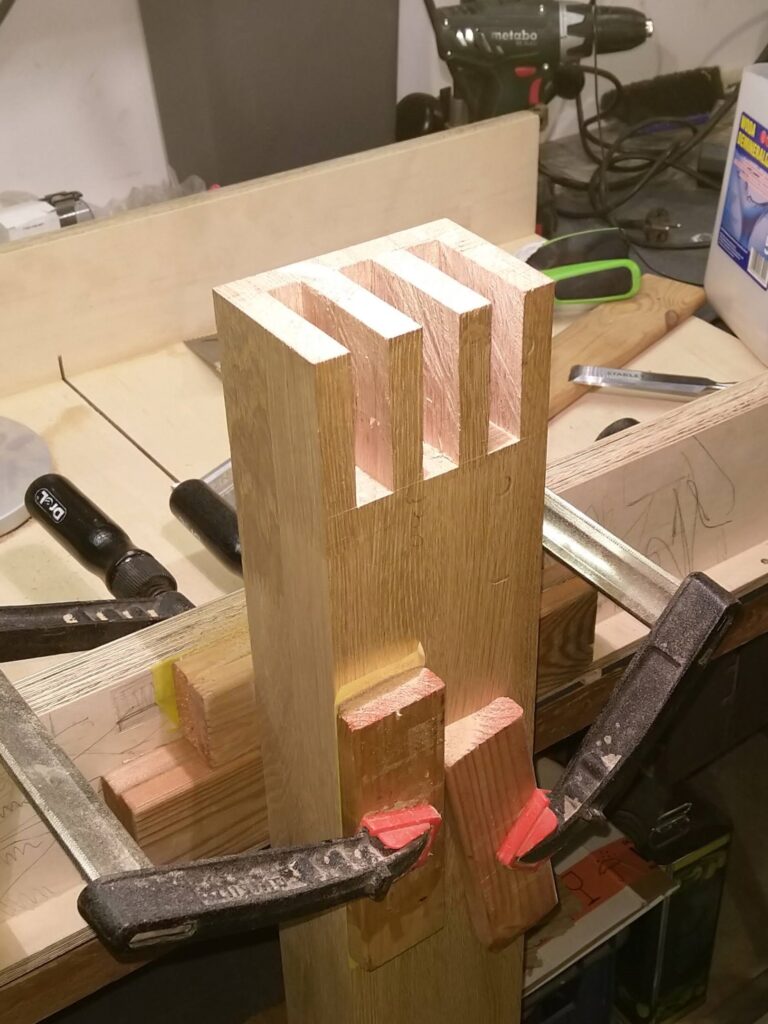
Once the first leg was ready I first made the teeth in the beam to see if I could make them fit together and see if maybe I would need to make some adjustments to my groove making process. Making the teeth was easy compared to the grooves as I could saw the teeth through to the bottom and only minimal chiselling was required. I once again used my special clamp to help in sawing them straight.
Once the first set of teeth and grooves was ready I tried a dry fit… It didn’t fit immediately but after a little chiselling in select areas I was able to slide the groves over the teeth with a sufficient snug fit. The result is in the picture below. Having never done something similar before, I was very happy with the result.
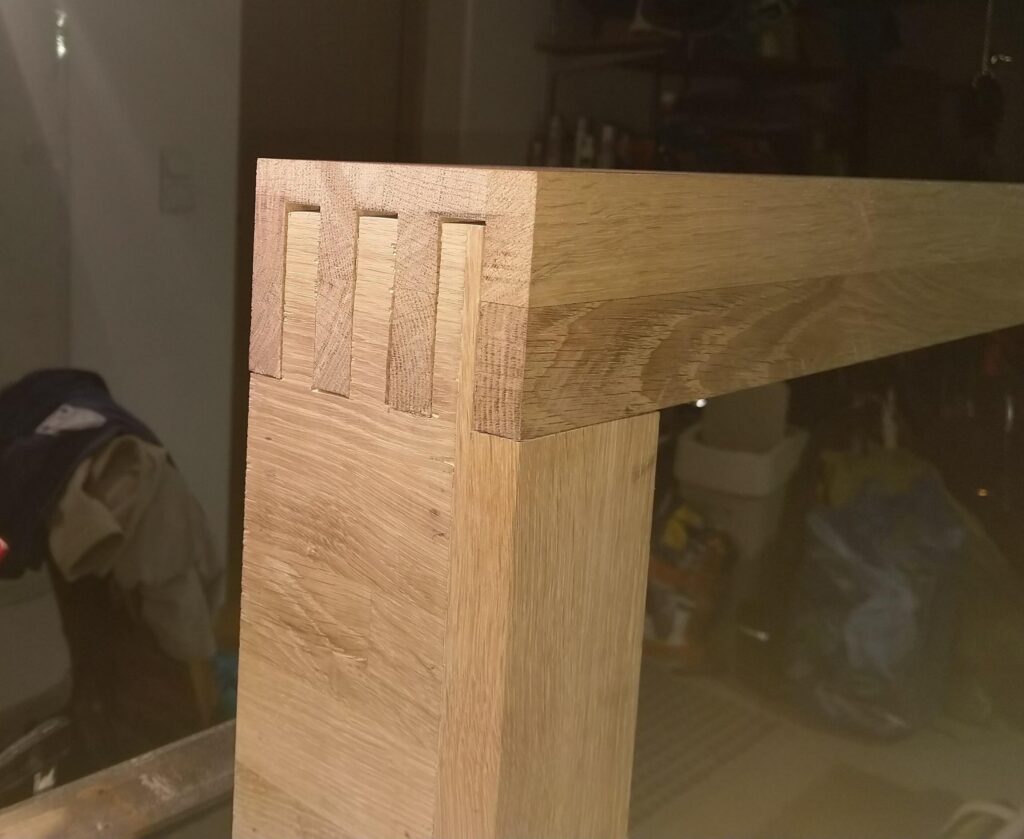
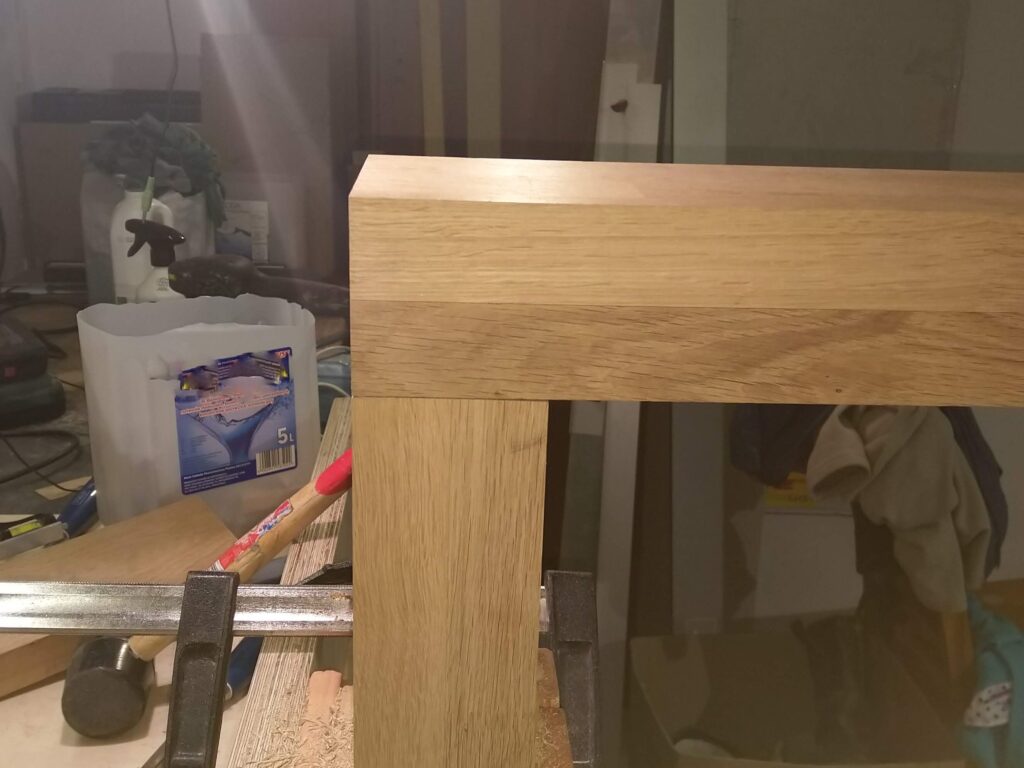
Now I just had to repeat this whole process 4 times with painstaking precision!!
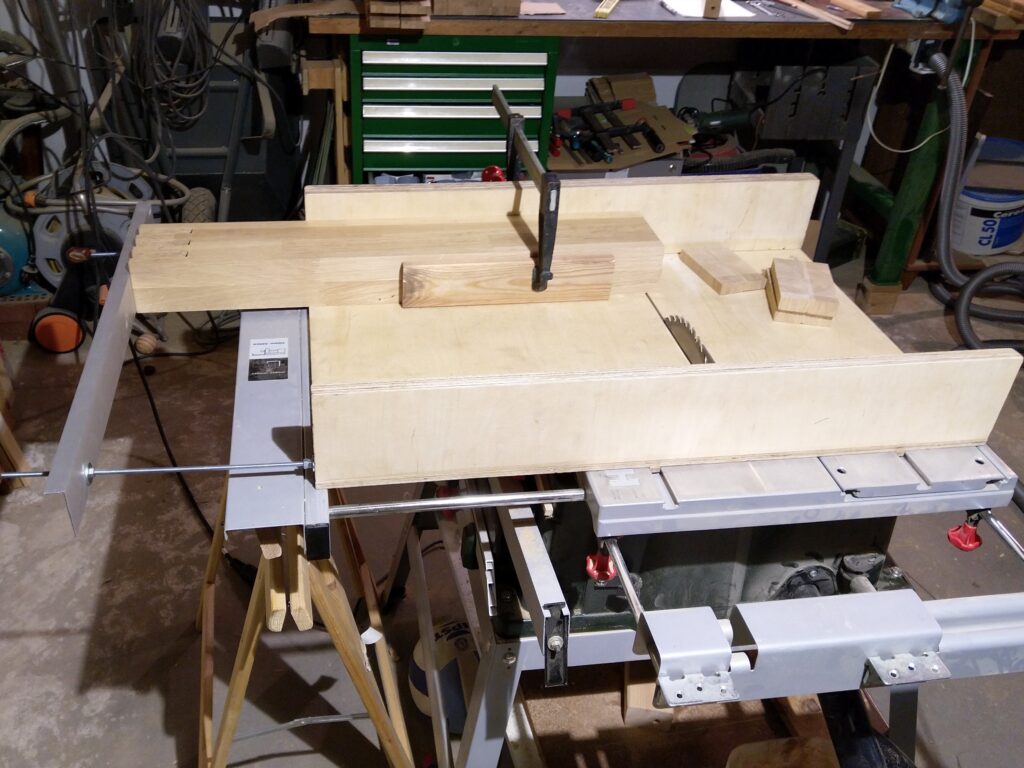
Three eternities later all grooves and teeth were ready and dry fitted and I took to cutting the 4 legs to the exact same length. I made an extended stop on my crosscut sled (lacking a mitre saw) to cut all 4 consecutively and than clamped them together to sand the bottom side.
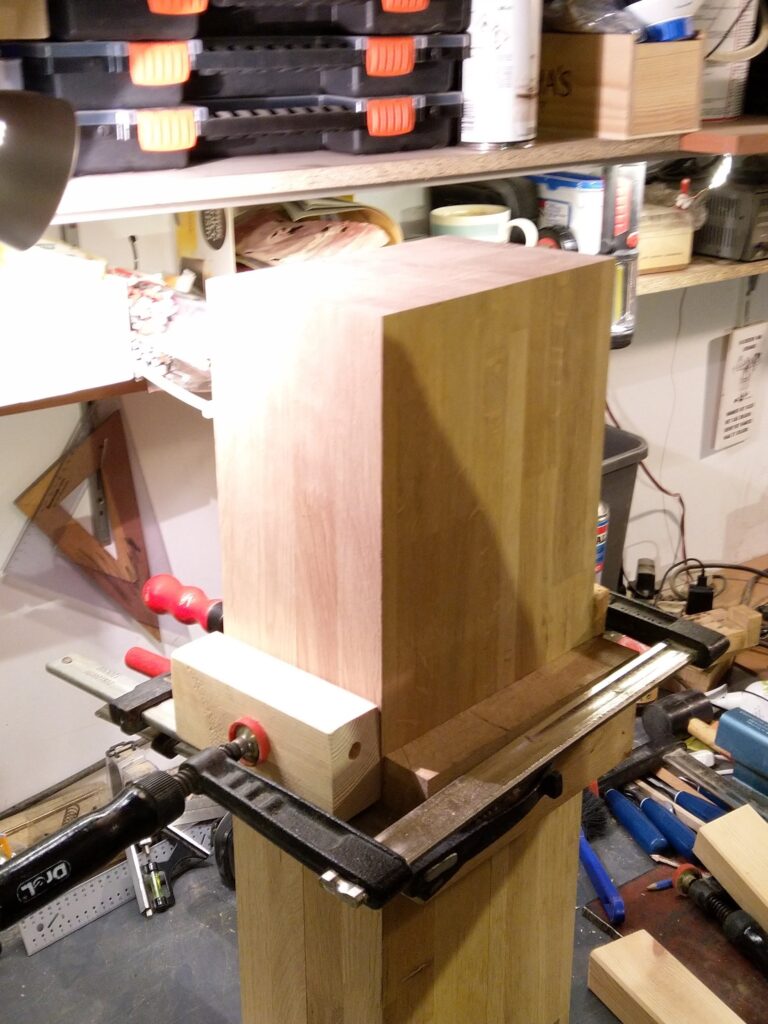
Before assembling the legs I cut 2 parallel channels in the top part of the beams. They would support the smaller beams I planned to make for the extensions.
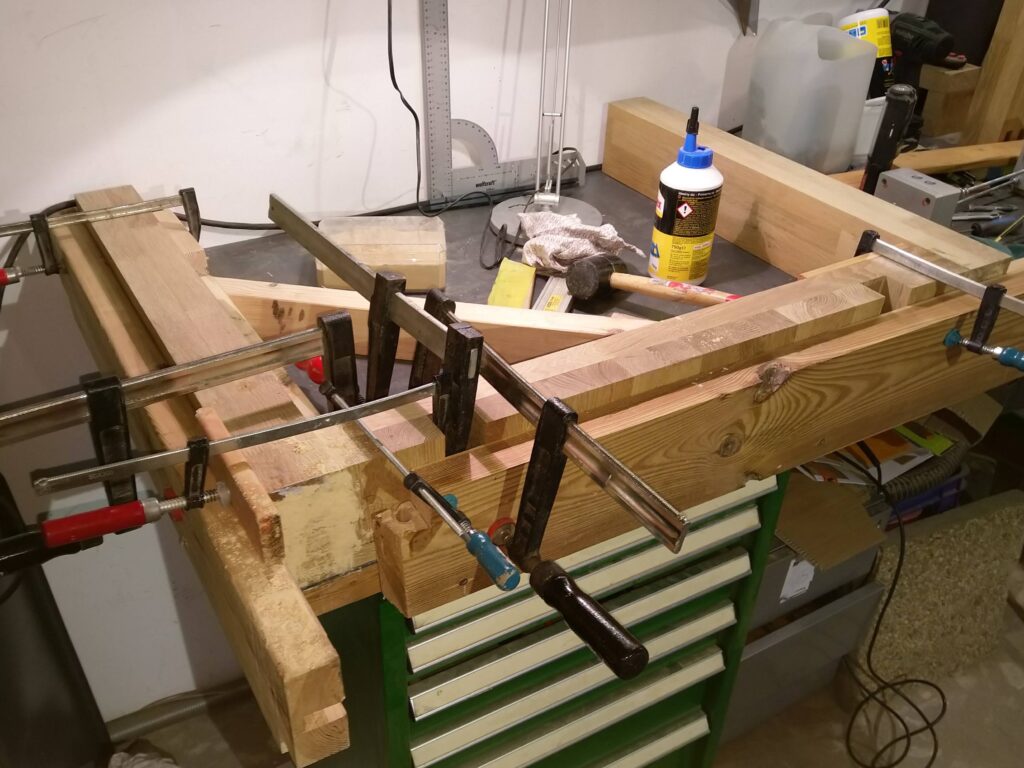
I screwed two wooden boards to both sides of a square corner of my workbench. These would serve as a template to assemble and glue the legs in a perfect 90 degree angle. Once one side of the leg was assembled, I flipped it over and did the other side.
Assembly method
While waiting for the glue to set for the legs I prepared the assembly method for the top and legs. I decided to screw inserts in the table top and bolt the legs to the table top with 8mm Allen bolts. This way, when wanted, the could be easily detached again. I wanted the legs and the top to reinforce each other mutually in regards to the extension beams which would be slid in the slots in the legs so I made sure to put in enough bolts.
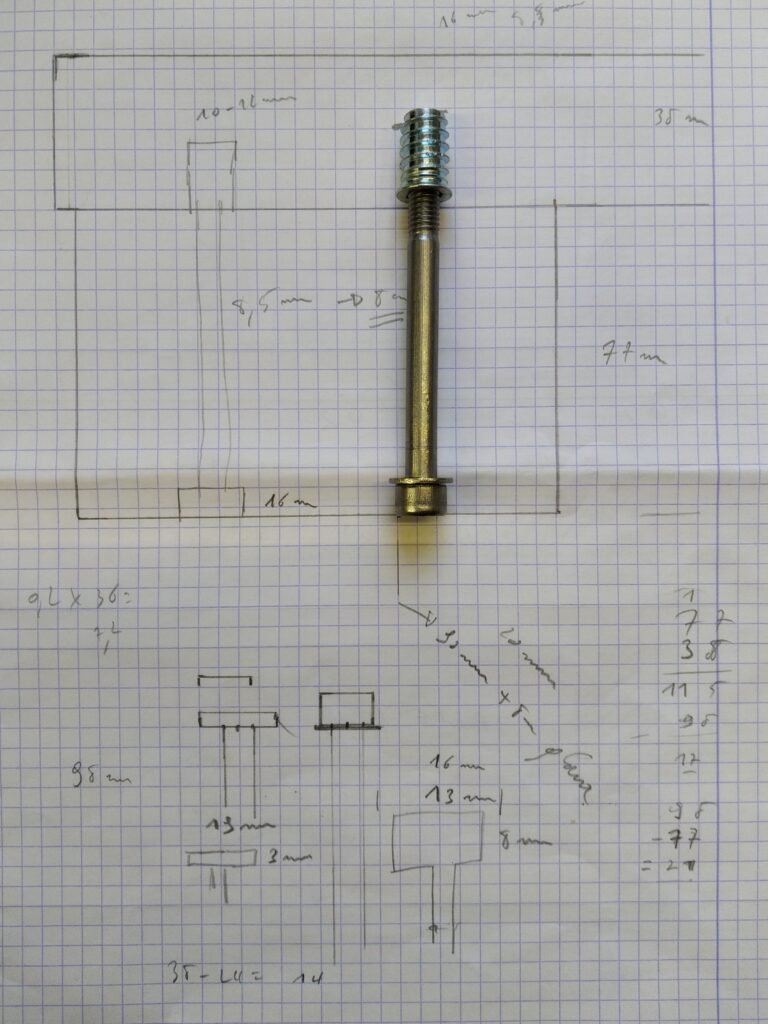
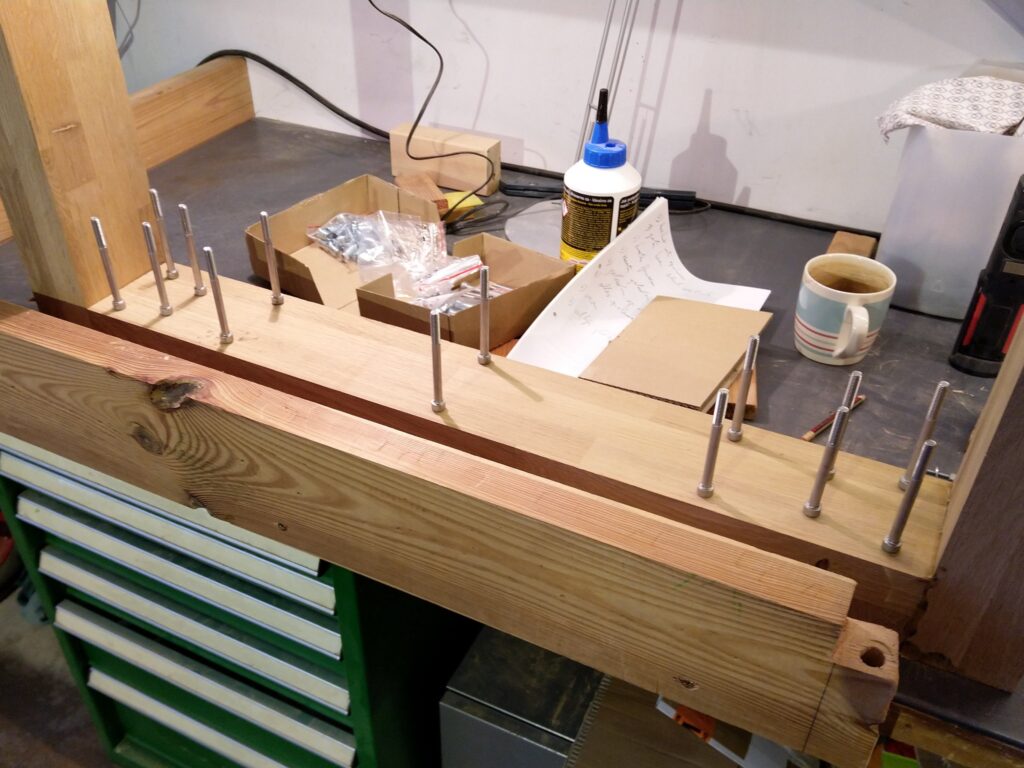
Given the number of bolts, it was important that they would perfectly align when assembling. I took special care to follow a sequence of steps which would maximise the chance of success.
- Drill 16mm countersunk holes for the washers and allen bolt’s head in the legs. Do not forget a drill stop.
- Drill in the centre of the countersunk holes through the legs with a 10mm drill.
- Clamp the legs to the upside down table top.
- Marked the location for the inserts on the table top with a 10mm drill through the holes in the legs.
- Remove the leg and drill the holes for the inserts with a 10,5mm drill. Do not forget a drill stop.
- Slightly countersink the holes for the inserts.
- Screw in the inserts.
Once all inserts were installed I fitted the legs to the upside down top to test. All fitted perfect.
All was ready now for the finishing touches. Unfortunately I made a few light scratches and dents in the table top during the building process. I sprayed some water on the damaged parts, let it soak a while and then I heated the damaged area shortly with the tip of a steam iron. I was able to remove all damages!
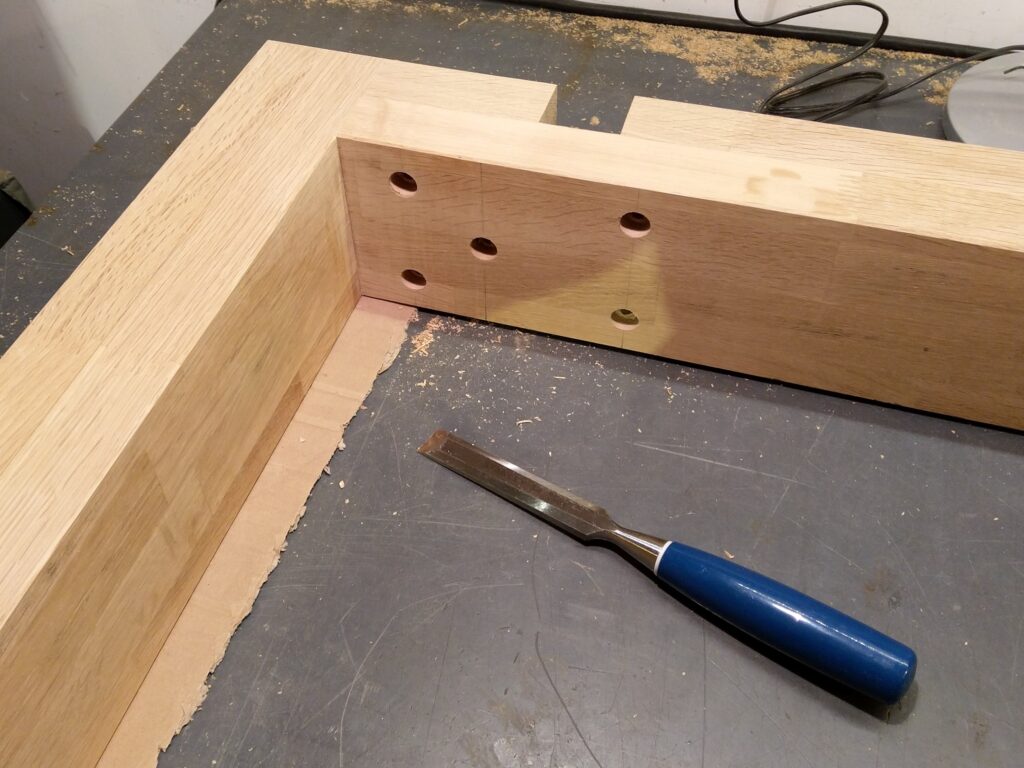
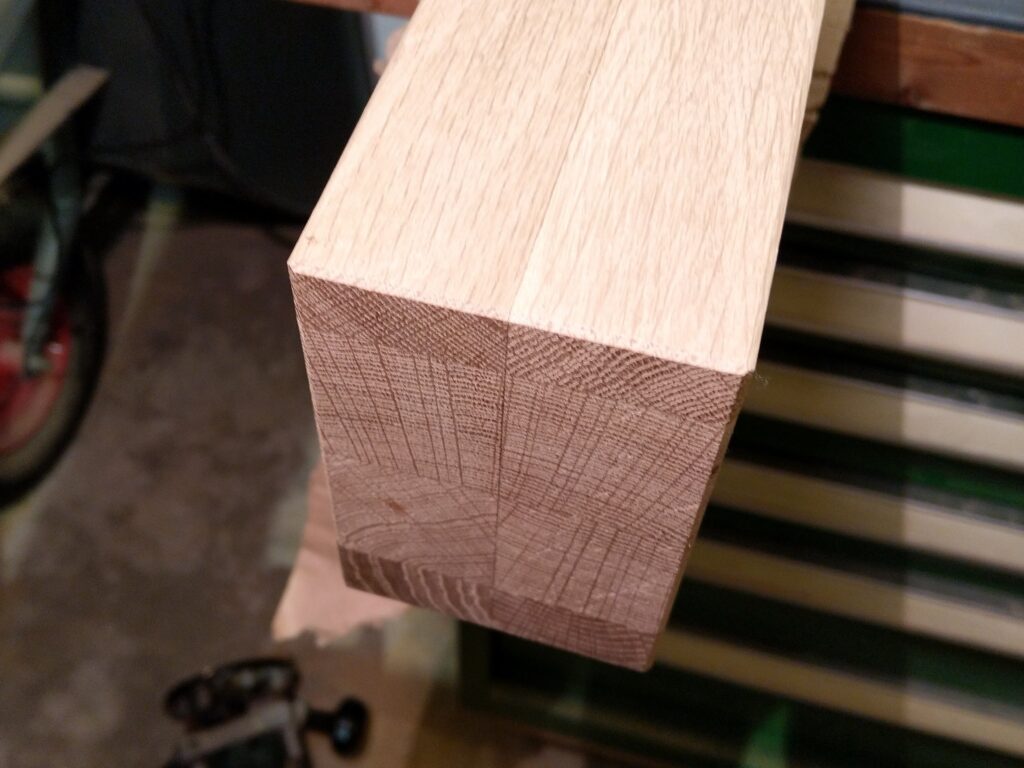
Finally I gave all the edges of the top and the legs a slight chamfer with a router and finished the inside corners with a chisel. I grinded all surfaces with 120 grit and in the end with 240 grit.
Finish
I wanted to protect the table with a very durable wood finish. Osmo polyx-oil original can be used for floors and kitchen tops so I expect it to be highly scratch resistant. It also seals the wood so it becomes water resistant. I also found that it is quite easy in its application. I find that it applies like an oil and hardens like a varnish. For this table I took a clear matt finish (code 3062). I am convinced that over time, as the table gets used intensively, any usage traces will be less noticeable on a matt finish than on a glossy finish.
This finish doesn’t require any special products to maintain it. A damp cloth and some soap suffices to clean the table.
A final advantage of this finish is that, when renovating or recoating a surface already covered with the oil, a clean and dry surface is sufficient. So no need to sand the table back to the bare wood.
Having used this finish on various projects and 6 years of intensive use of this table, I can really recommend it.
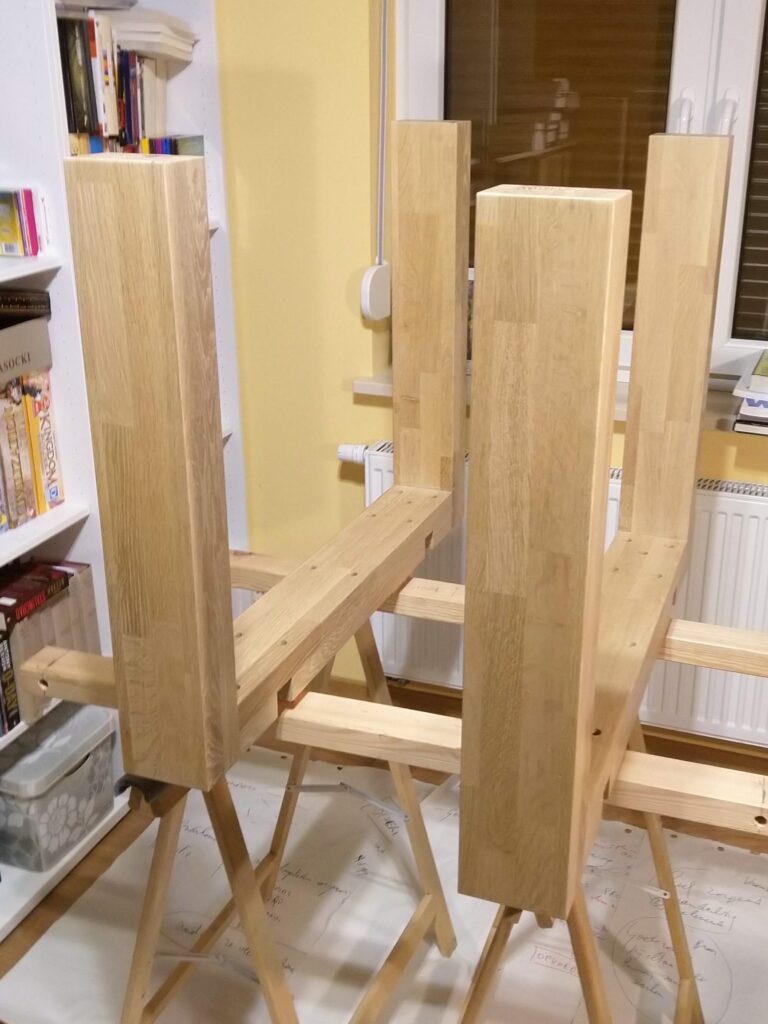
To prepare the table for applying the finish, I vacuumed it thoroughly and cleaned everything with a microfiber cloth and some acetone. I positioned the legs and the extension beams so that I could cover them completely in one sitting. I applied the finish thinly with a microfiber roller and about 9 hours later I applied a second thin coat. I let it cure for a couple of days before doing the final assembly of the table.
Assembly
To assemble the table I put the top on two sawhorses. With some wooden blocks I made sure that the top was a little more than the height of the legs above the ground. Before mounting the legs I cut some felt pads to size from a big sheet and glued them to the bottom of the legs. I then slid the legs under the top and lightly screwed them to the top. I removed the saw horses and when the table was resting on it’s feet I tightened all the screws…
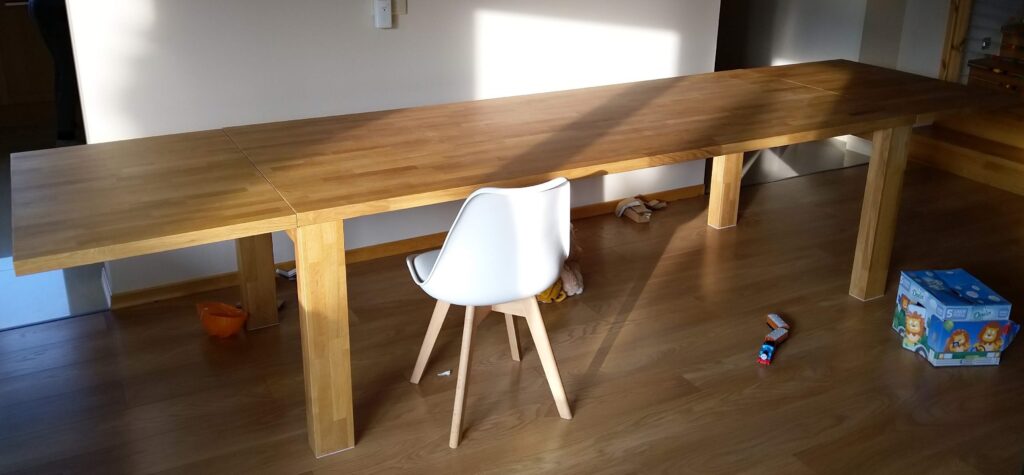
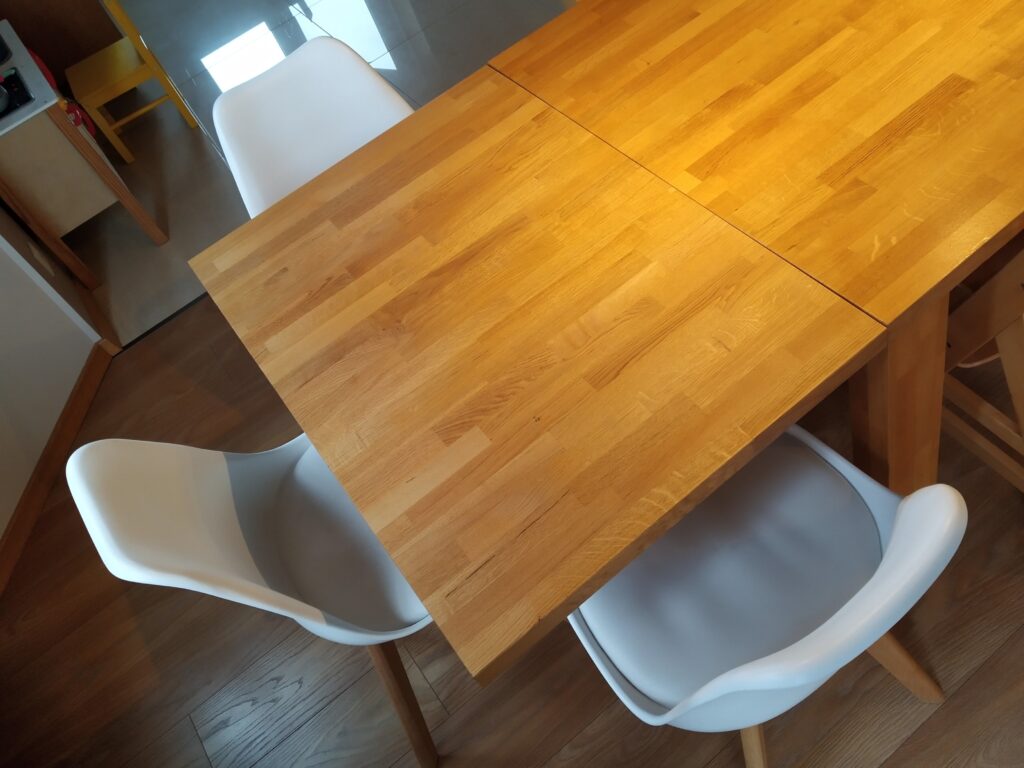
I slid in the support beams for the extensions and put on the extensions. The boards I glued up for the extensions were a little longer than planned so they became 67cm long instead of the initial 60cm. So in its extended configuration the table is 374 cm long. Sufficient to sit 14 people comfortably.
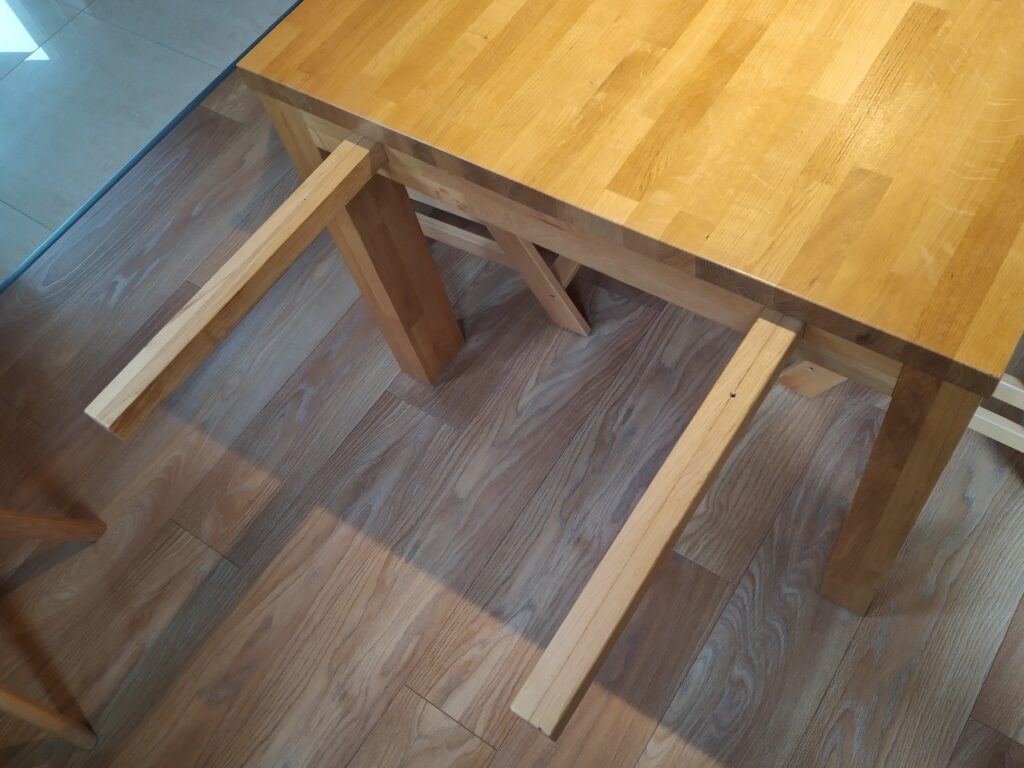
The support beams for the extensions are slid into slots which I made into the beams of the legs. As we only install the extensions a few times a year, I just put the extensions on top of the beams and fix them to the support beams with a screw from below. I have a solution with some slots so they can just be slid into place but I didn’t have the need nor the time yet to implement
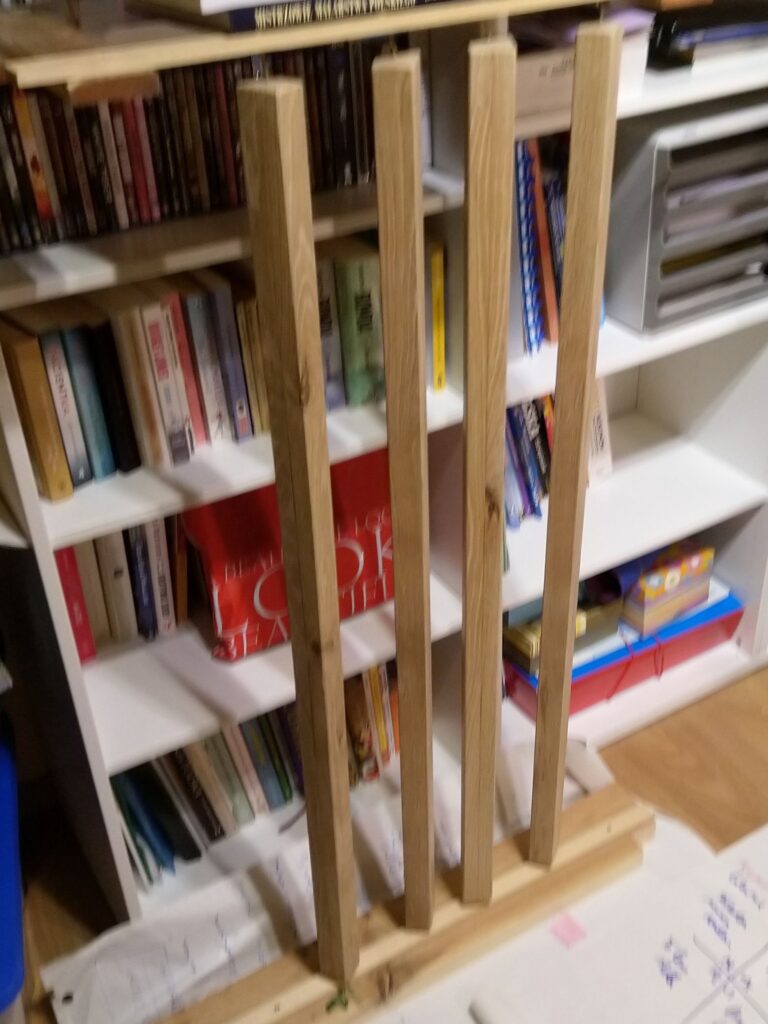
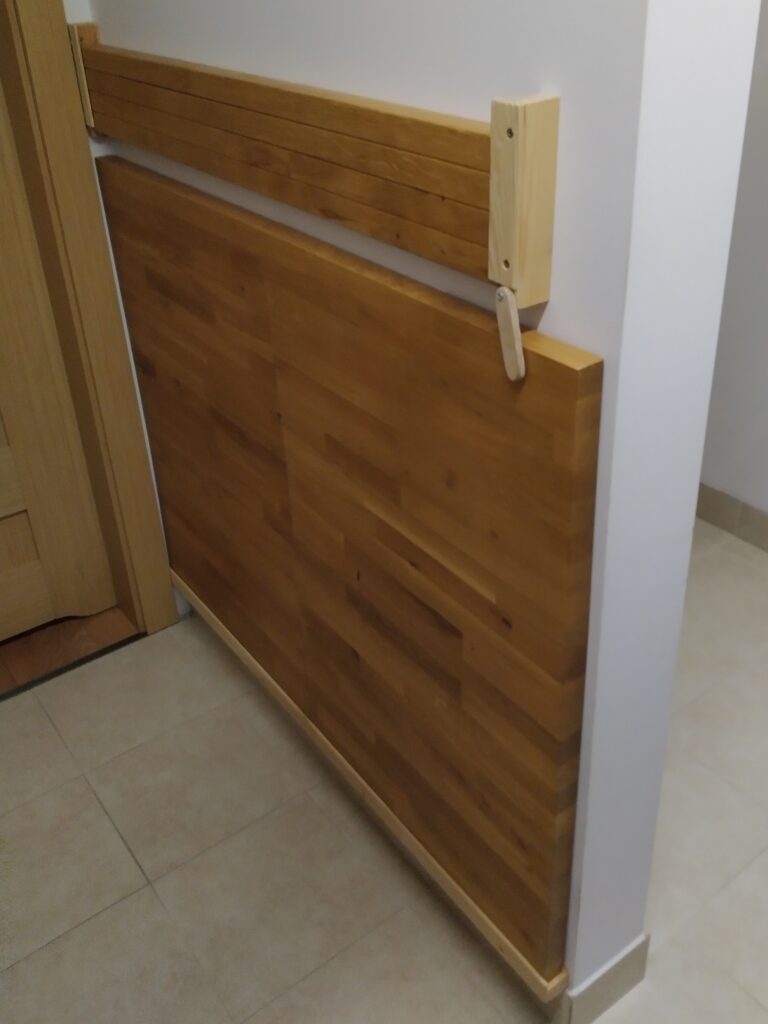
When we don’t use the extensions we store them against the wall in a small storage space under the stairs. I made a some brackets and supports against the wall to store the parts conveniently. When the extensions are not used, the holes in the beams of the table are filled up with some blocks to make them look nice.
Let me check back on the list of requirements I set out at the start of this project:
- Solid? Yes, the legs and top behave as one part, the table is not wobbly at all. And what about the 4cm top? Well, I (90 kg :-)) can stand on it in the middle and it does not move a bit.
- Easy in daily use and easy to clean? Yes. It has a plain table top and has a maintenance free easy to clean high quality finish.
- Shine by simplicity? For me it does.
- Sit 10 to 14 persons? Affirmative.
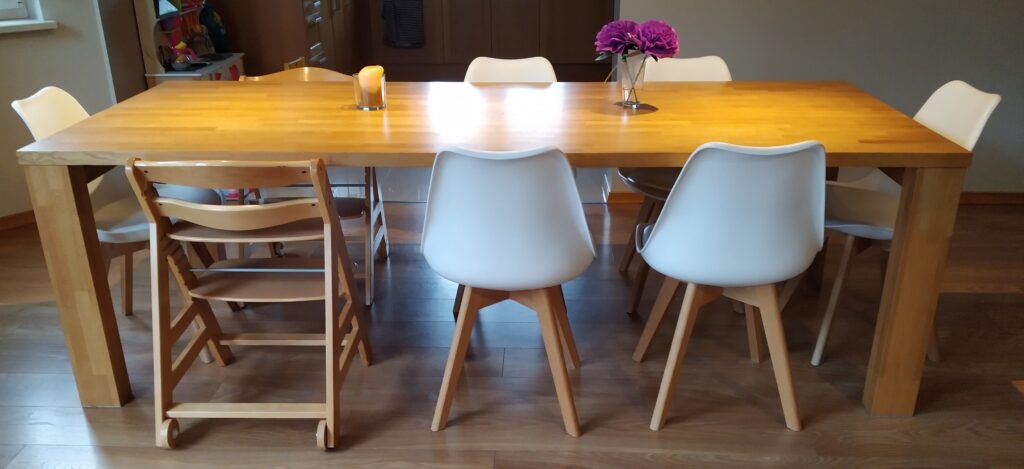
This table really has become the centerpiece of our daily life. It is big enough so we can play a game or do some crafting at one side without the need to clean everything when we eat. And when we have more guests we can sit them without too much hassle.
LESS IS MORE